
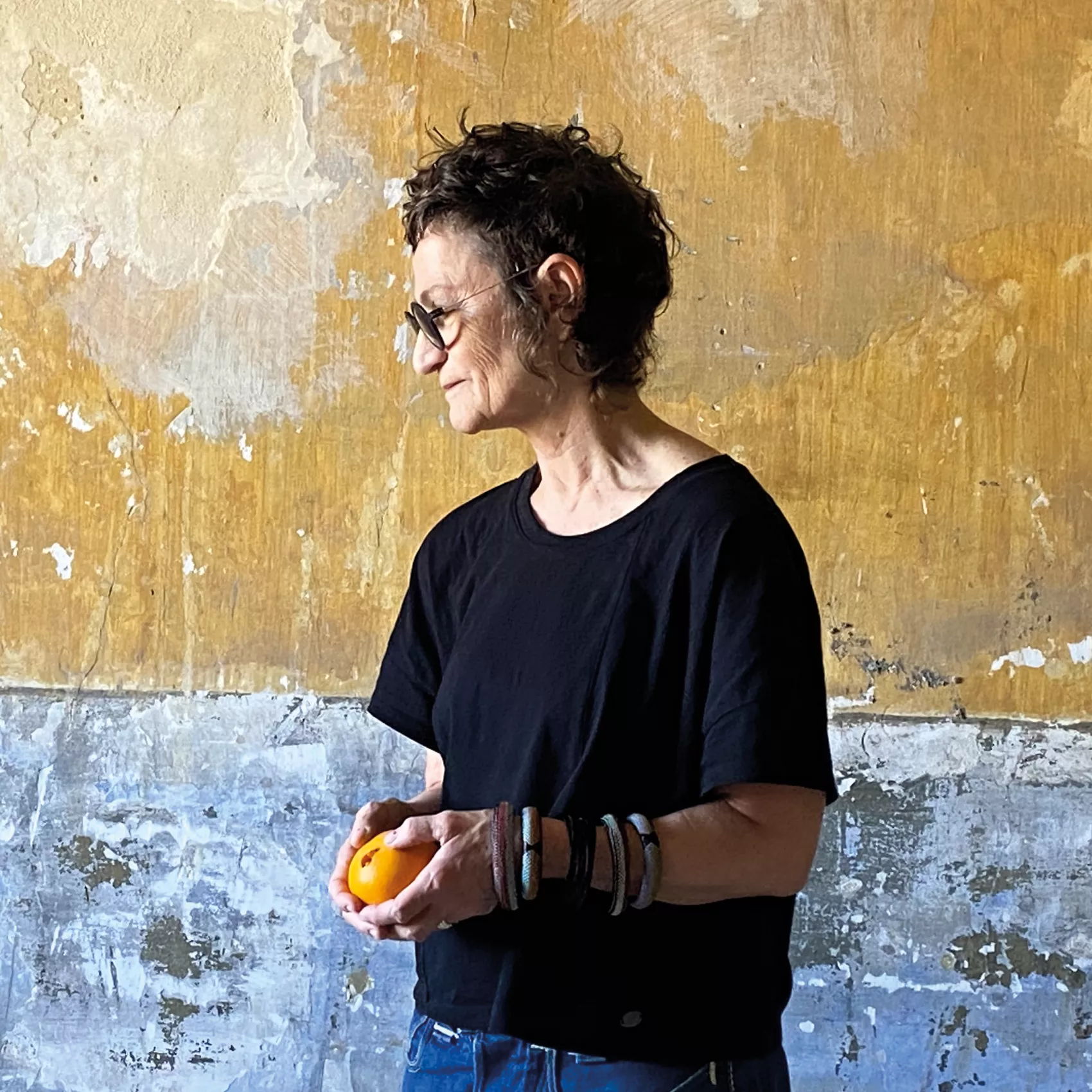
Robyn Orlin
CITY THEATER AND DANCE GROUP
Born in 1955 in Johannesburg, Robyn Orlin began developing her choreographic practice and culture from childhood onwards, in an environment that was hostile to all forms of discrimination, including on aesthetic grounds: from Zulu dances to Merce Cunningham, from hip-hop to classical ballet… whatever their form and wherever they came from, all forms of dance found favour with her. And the aesthetic eclecticism she displays – this ‘universalism’ – whether choreographic, musical, cinematic, visual or literary – has become one of the defining features of her artistic style.
Trained at the London School of Contemporary Dance (1975–1980), then at the Art Institute of Chicago (1990–1995), Robyn Orlin began her career as a dancer, choreographer and teacher in South Africa, where she was quickly recognised, both for the uniqueness of her artistic vision and the chaos that characterises her work, and for her active commitment to the anti-apartheid cause.
At the turn of the 2000s, her (multi-award-winning) play Daddy, I have seen this piece six times before and I still don’t know why they’re hurting each other, which satirises the difficulties and trials of the fledgling ‘Rainbow Nation’, as well as classical ballet as a vehicle for discrimination, enabled her to tour Europe and secured her international recognition. From then on, France became her creative base: there she made her first film, *Beautés cachées, sales histoires* (Ina/Arte, 2004), her first opera,
Handel’s L’Allegro, il penseroso ed il moderato (Opéra Garnier, Paris, 2007), numerous solos for performers from diverse backgrounds, and her first theatre production, Les Bonnes, based on Genet (Théâtre de la Bastille, Paris, 2019). At the same time, she continued to work in South Africa, where she created, notably, Still Life with homeless… for the Via Katlehong company (2007), Walking next to our shoes… with the singer-dancers of Phuphuma Love Minus (2009), Beauty remained for just a moment… (2012) and we wear our wheels with pride… (2021) with the Moving into Dance company.
The world of this prolific artist is characterised, as has been said, by a blending of forms, expressions and genres; by the joyful chaos she creates both on stage and amongst the audience at her shows; by her critical and political stance; and by her strong visual artistry. It is also recognisable by the presence of certain motifs that recur obsessively: tutus, for example, oranges, or, perhaps more mysteriously, ducks – alone or in groups and made from all manner of materials; ducks of every kind, size and colour.
Myriam Bloedé