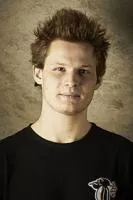

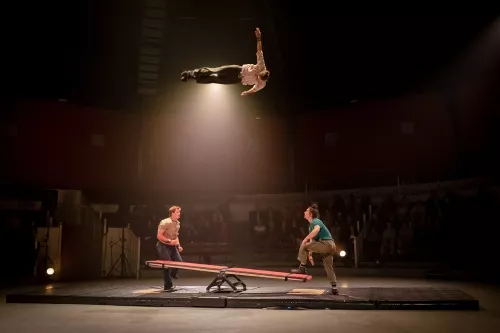

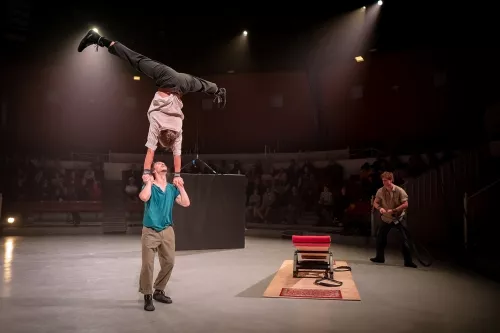
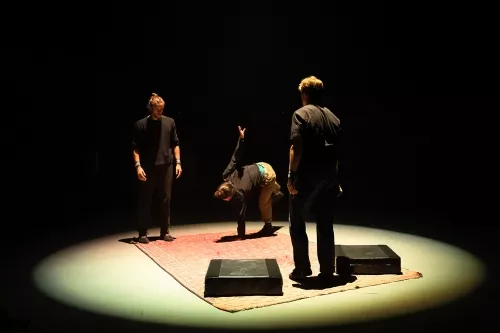

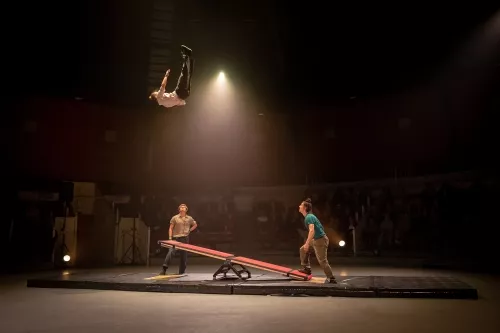
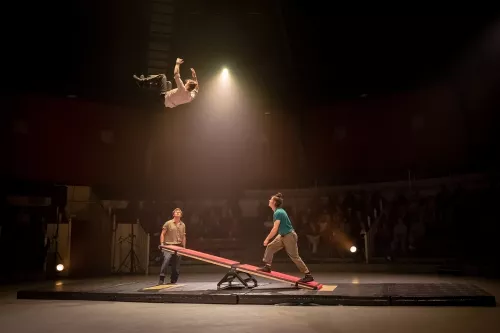
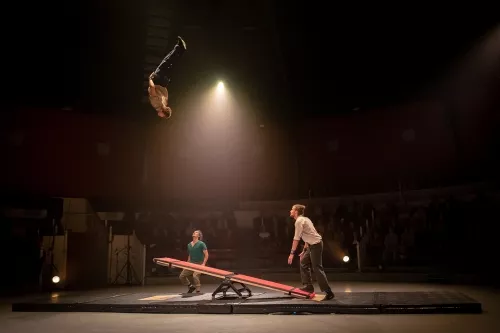
Thales is of Belgian origin and currently lives in France. After discovering the Korean teeterboard at a small youth circus school in Antwerp, he continued practicing with Niels Mertens. A few years later, Tiemen Praats joined them, and together they formed a Korean teeterboard trio.
When they entered the École nationale des arts du cirque de Rosny-sous-Bois (ENACR) in a preparatory year, Thales discovered several other interests beyond teeterboard, particularly technical roles and everything related to rigging, as well as safety lines for flying trapeze. He also developed his artistic perspective on teeterboard.
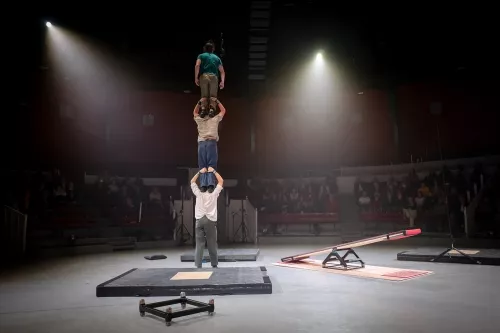
The trio then joined the Centre national des arts du cirque, continuing their practice of Korean teeterboard. Today, they have formed a six-person collective, expanding into acrobatic lifts and the Hungarian teeterboard.
In parallel, Thales continues to train in technical rigging, safety lines, and trapeze work. He recently completed the module “Installation of sound and lighting systems” as part of the circus technician training program developed by the CNAC’s FTLV (lifelong training) department, and his interest in dramaturgy and stage lighting effects is growing.
His dream is to go on tour with a circus tent and the six-person collective. Within this project, he would like to challenge and evolve people’s expectations of teeterboard practice, starting from the idea that with work and determination, anything is possible—especially under a big top.
Trio “Sans Interdit” – Belgium – Korean teeterboard
The trio “Sans Interdit” is composed of Niels Mertens, Tiemen Praats, and Thales Peetermans—three individuals with distinct backgrounds and a shared passion. They met in 2012 at the Belgian youth circus school Ell Circo D’Ell Fuego in Antwerp and began practicing the Korean teeterboard as a trio in 2017.
After building strong technical foundations in a highly demanding training environment, the trio joined the École nationale des arts du cirque de Rosny-sous-Bois (ENACR) in 2018.
In 2019, they continued their studies at the Centre national des arts du cirque. During these four years of training, they had multiple opportunities to collaborate with circus and dance artists and directors such as Dominique Bettenfeld, Bertrand Bossard, Kaori Ito, Guy Alloucherie, and Tuur Florizoone, all of whom contributed to shaping their artistic vision of teeterboard and circus practice.
They named their trio “Sans Interdit” (Sæns), a wordplay that expresses their exploration of the “forbidden directions” of the teeterboard. This reflects their artistic and technical approach, which moves away from traditional circus codes. They aim to challenge the usual perception of danger associated with teeterboard on stage, while fully embracing their passion for propulsion and flight.
The trio is strongly driven by the desire to détourner (reimagine) the Korean teeterboard. Their main goal is to expand their physical and technical abilities by integrating other circus disciplines that complement their practice. For example, they have developed the “flying teeterboard,” a structure allowing them to practice teeterboard at height without touching the ground. This technical innovation opens new perspectives for creation and research, as well as reflections on lighting and stage curtains—on what audiences see and do not see in performance.
In parallel, during their second year at CNAC, while working on repertoire reinterpretation, they collaborated in a very positive atmosphere with three other students from their cohort: Alice Binando, Tomàs Denis, and Yannis Gilbert. They formed a multidisciplinary collective combining acrobatic lifts, teeterboard, acrodance, and rope work, with the intention (once becoming professional artists) of continuing together toward a first shared creation.