

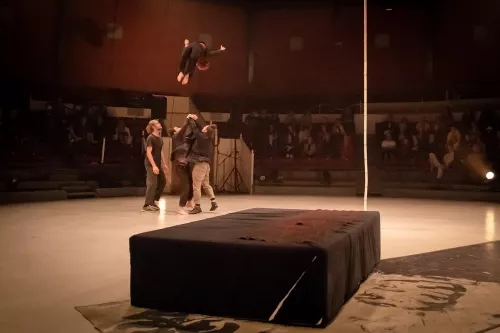
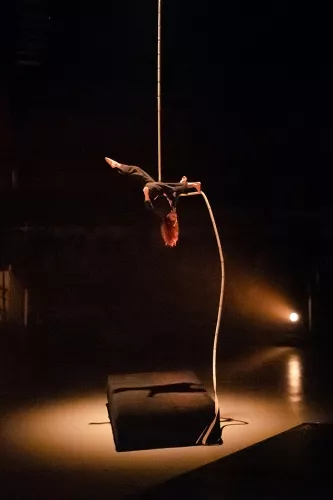
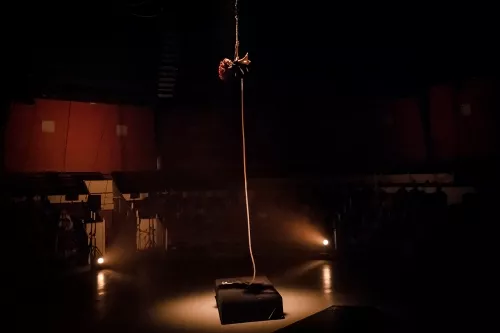
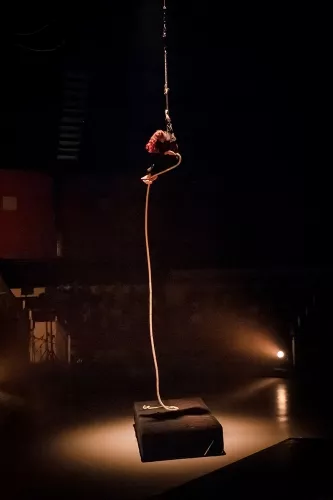
Alice Binando was born in a small village in northern Italy, where she grew up among cows and green meadows. By chance, she discovered circus arts at the age of 18, which she practiced with her mother. Deeply shaken by this new world, she began to question her conventional understanding of reality and work.
She eventually decided to leave her rural life and her profession in western-style horse riding to pursue a career in circus arts.
Encouraged by her amateur circus teacher, she joined the FLIC Scuola di Circo and settled in Turin. She chose rope as her main discipline and also integrated acrobatic partnering into her training. Constantly undecided about her specialization, she ultimately chose… not to choose, and to keep both practices.
She later left her home country to live in Barcelona, driven by a desire to travel and broaden her vision of circus arts.
She continued her training at the Centre national des arts du cirque, where she formed a collective focused on the Hungarian cradle and partnering work with three bascule artists and two other acrobats.
She maintains a strong connection to both rope and acrobatic partnering, and dreams of combining them.
Throughout her journey, she has been influenced by several creators who shaped her artistic research, including Roberto Magro, Francesco Sgrò, Piergiorgio Milano, Guy Alloucherie, Florent Bergal, François Juliot, Petr and Matěj Forman.
Alice has always had a complex, almost love-hate relationship with her apparatus and is deeply interested in the notion of skin and physical contact. The fleshy body plays a central role in her imagination.
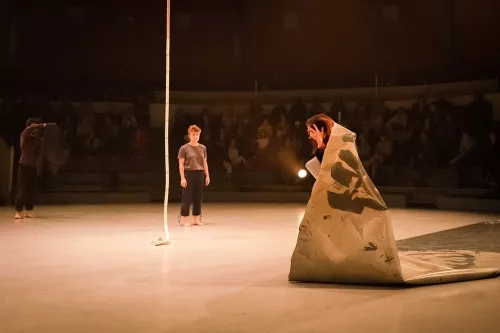
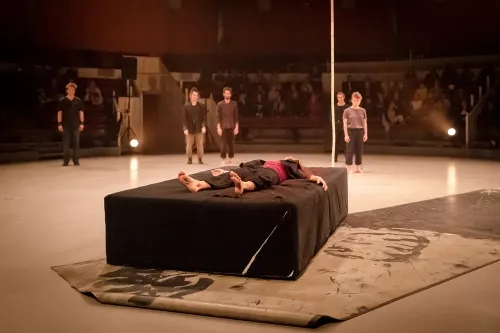
She observes the impact of circus apparatuses on the body, which is continuously burned, struck, scratched, crushed, and bruised. She asks: how does the body communicate physically with a circus apparatus? Or how can the apparatus transform an individual’s physicality?
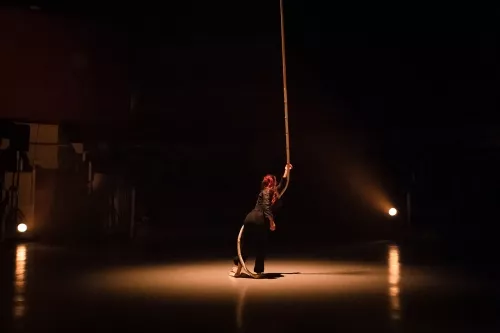
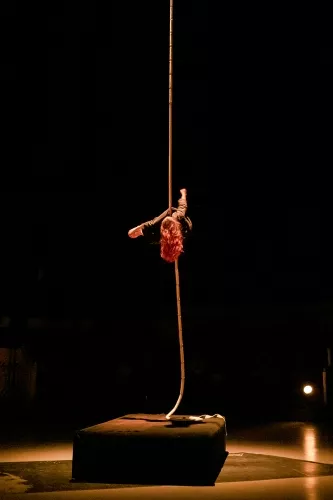
She then experiments with variations in the use of the vertical rope, modifying its strength, material, and the consistency of the coated rope. Physically and rhythmically, she develops qualities reminiscent of honey: heavy, slow, dense, voluminous—then suddenly flowing, fast, sliding, and spreading chaotically when it falls.
The honey sticks to extend itself, to move, to persist, stubbornly.
Alongside circus, Alice writes in her many notebooks, tinkers, and grows plants.